


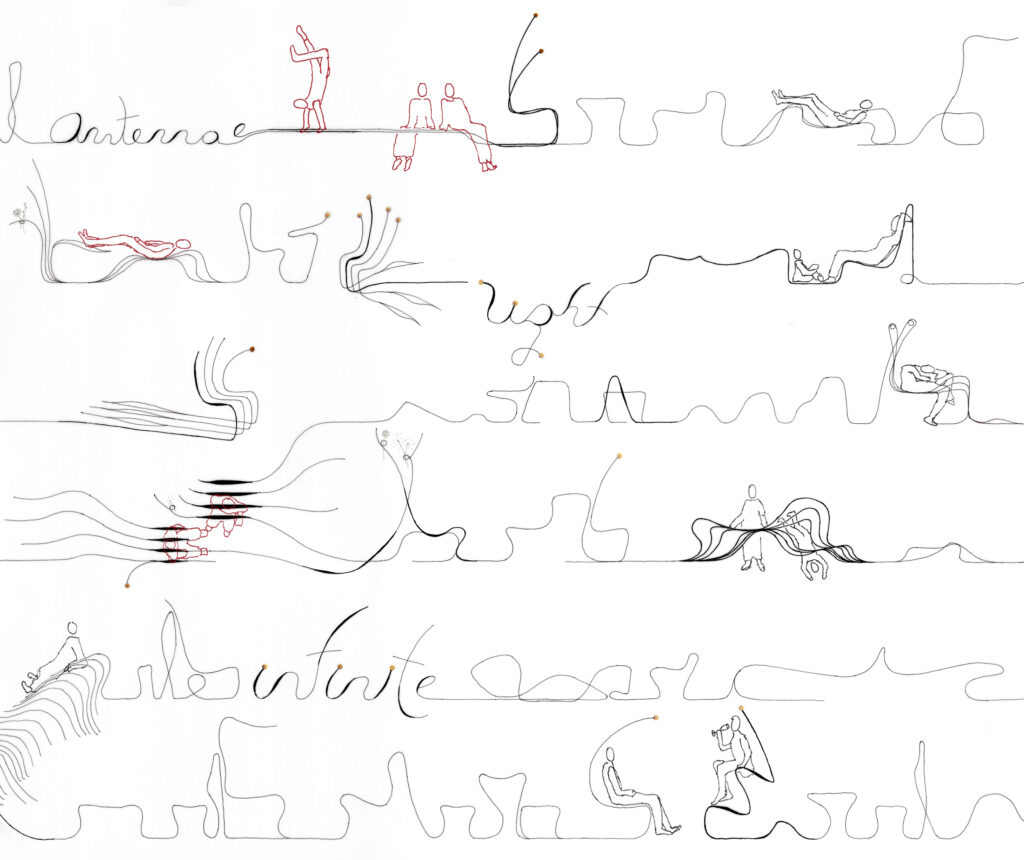

It is late afternoon. The city is still warm. A body pauses before deciding where to sit.
The bench is narrow. The edge is hard. The posture feels predetermined. Sitting means sitting upright, facing forward, for a limited amount of time. Lying down is not allowed. Leaning is uncomfortable. The body adjusts, shifts, negotiates.
In that brief moment of contact, before any building or street comes into focus, the city is experienced through posture. Through touch. Through the surface that receives the body. The Living Chair emerges from this perception.
The chair as an architectural question
The question posed by the 2025 international competition The Architect’s Chair (Buildner) seems simple. Architects have designed many chairs. Especially within modern and contemporary architecture, the chair has been a recurring object of experimentation, from iconic designs to more speculative ones. It almost feels inevitable that an architect, at some point, will design a chair.
This fascination is not accidental. The chair is the most complex piece of furniture to design. More than a table, more than a shelf, more than a lamp, the chair demands an intimate negotiation with the human body. It must respond to posture, weight, balance, rest, and movement. It must consider ergonomics, but also habits, cultures, and different ways of inhabiting the world.
The first skin that surrounds the body is clothing, and then comes the chair. The next would be the room. As a surface that receives the body, the chair operates as architecture at its most immediate scale, where form meets the exact dimension of the human body.
This understanding was already present in some of the earliest modern furniture designed by European architects, particularly German and Dutch designers. Figures such as Mart Stam, Mies van der Rohe working with Lilly Reich, and Marcel Breuer presented their work at the Weissenhof Siedlung housing exhibition in 1927, during the interwar period. Through these experiments, new materials were introduced, and metal became a central medium for rethinking furniture design.
And yet, while architects have designed many chairs, there are surprisingly few urban chairs conceived with this same care. Even fewer pieces of urban furniture have been designed starting from the body. Cities are full of benches, edges, and places to sit, but most assume a single posture, a single duration, and a controlled way of occupying space.
The urban chair as landscape
We decided to take the competition opportunity to design an urban chair, conceived as a furniture-landscape: an inhabitable surface and an infinite line capable of operating as urban furniture.
Unlike interior furniture, which has advanced through innovations in ergonomics and materials, urban furniture has remained largely static and uniform. As both Be Seated by Laurie Olin (2017) and The Social Life of Small Urban Spaces by William H. Whyte (1980) show, the design of seating directly shapes how public space is occupied, perceived, and valued.
The Living Chair emerges from this decision. Not as an isolated object, but as urban furniture that can exist both inside and outside. Not as a fixed form, but as something closer to a landscape: a surface that can be inhabited in multiple ways, individually or collectively, briefly or for extended periods of time.
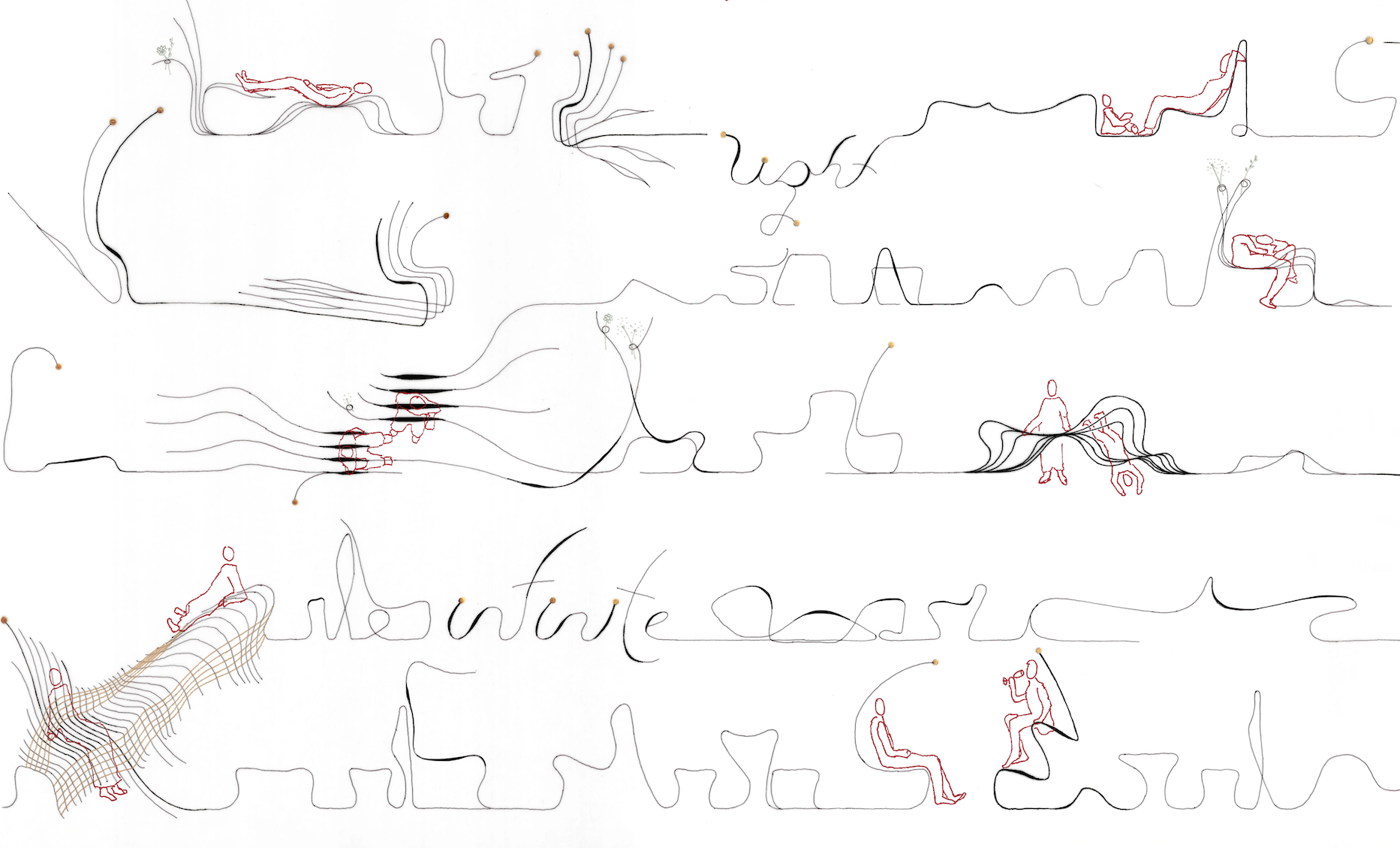
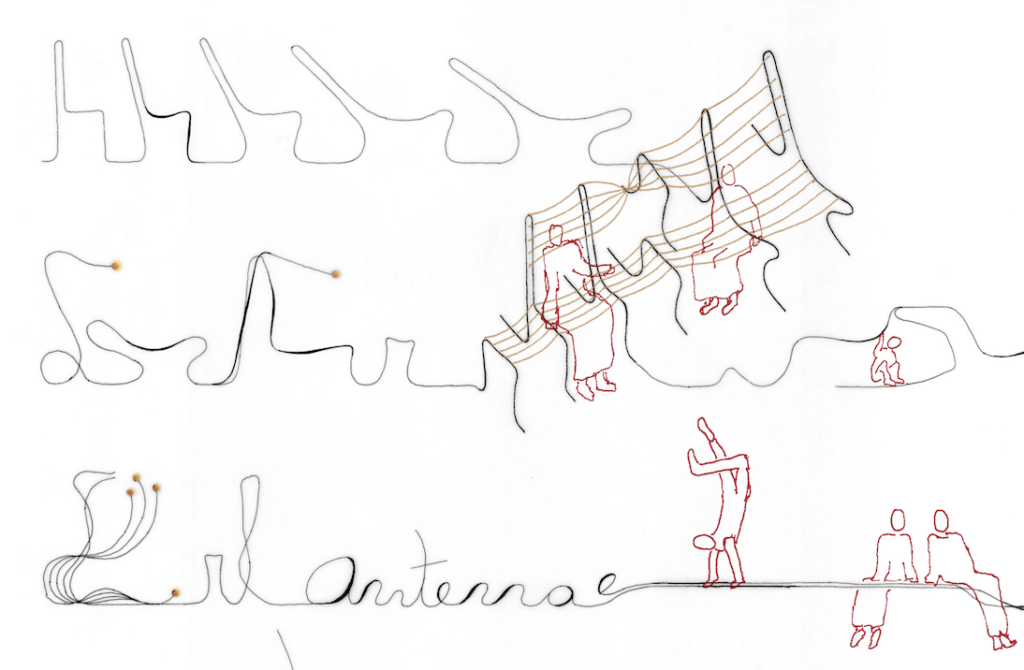
The Living Chair is conceived as a living system, an infinite and adaptable structure that unfolds like a continuous line. Almost like a piece of calligraphy drawn in space, it reaches the ground, rises, bends, expands, and contracts. It does not prescribe a single posture. Instead, it offers a wide range of bodily possibilities: sitting, leaning, lying down, gathering, playing with children, socializing, flirting, resting, reading, observing. The chair adapts to what the body asks for, not the other way around.
As urban furniture, the Living Chair supports both individual and collective use. It allows bodies to approach or distance themselves, to sit together or apart, to share space without obligation. It can be inhabited alone or in groups. Like a furniture landscape, it accommodates different ages, rhythms, and intensities of use.
Materiality as a living organism
Materiality is central to the Living Chair. When looking at chairs designed by architects throughout modern history, a recurring logic appears: structure and skin, skeleton and surface, support and contact.
In chairs by Marcel Breuer or in the furniture designed by Mies van der Rohe together with Lilly Reich, structure is made explicit. These chairs are almost anatomical: a visible frame and a surface that follows the body’s form. A similar distinction appears in the Chaise Longue by Le Corbusier, Charlotte Perriand, and Pierre Jeanneret, where the body is carefully studied and accommodated. Here, furniture is conceived as an extension of the body, responding to rest, gravity, and comfort.


The Living Chair builds on this lineage, but shifts it toward the urban and the adaptable. Its structure is conceived as a system of flexible bamboo elements, working as a continuous skeleton. Varying in thickness, the bamboo provides both structural integrity and bodily comfort. Its elasticity allows the form to bend, yield, and subtly respond to pressure, enabling the body to actively affect the shape of the chair rather than conforming to it.
This bamboo skeleton is combined with a woven skin made from natural fibers, such as hemp or recycled textile strands. The skin does not fully cover the structure, appearing only in specific areas where the body makes more contact. The weaving remains breathable, soft, and slightly elastic, allowing weight, movement, and time to leave traces on the surface. Over time, the skin could biodegrade, disappear, or merge with the surrounding environment, framing furniture as temporal rather than permanent, evolving rather than fixed. The Living Chair behaves less like an object and more like an organism, adapting to use, climate, and time.


Form, calligraphy, and body awareness
Beyond materiality, the Living Chair is shaped by form understood as a bodily experience. It is not conceived as a closed object, but as a continuous line that unfolds in relation to the body. Form is not fixed; it adapts through movement, use, and contact.
A key reference for the design was Visiona 2 by Verner Panton (1970), an immersive environment where furniture, architecture, and body merge into a single spatial condition. In this concept, seating is no longer an object placed in space, but a terrain to be inhabited. This idea of furniture as landscape directly informs the Living Chair.
This approach is also present in Panton’s Multi-Level Lounger (1964), which abandons the idea of a single correct posture. Instead, it allows multiple bodily positions: reclining, leaning, stretching, sitting halfway, or lying down. The chair adapts to the body, not the opposite. This freedom of posture is central to the Living Chair.


The Living Chair also relates to non-Western ways of inhabiting the space. In Japanese culture, sitting on the floor, such as in seiza, introduces a different relationship between body and ground. Chairs are not always elevated objects; sometimes they are surfaces, gestures, or minimal interventions. In this sense, chairs can also be understood as cultural artifacts, not only ergonomic devices.
This understanding connects to the idea of chairs as art, where furniture moves beyond function and becomes an expression of bodily awareness. The Living Chair embraces this ambiguity. It is functional, but it is also experiential. It invites the body to explore, adjust, and choose.
The continuous line of the Living Chair is inspired by the calligraphic drawings of León Ferrari, in which line becomes movement, density, and tension rather than legible text, suggesting infinity through repetition and variation. Translated into space, the Living Chair behaves like a calligraphy drawn in the city: the line thickens, loosens, overlaps, rises, and descends, allowing different forms of inhabitation to emerge. Body awareness is not imposed here; it is discovered.
Sensoriality, light, and care
Light plays a central role in this sensorial dimension. The Living Chair incorporates small, movable, solar-powered lights, conceived as subtle extensions of the structure, almost like antennas, responding to practical needs while shaping perception, atmosphere, and orientation in public space. Light allows the chair to be used at night, extending the life of public space beyond daylight hours and supporting reading, waiting, resting, or simply being present in the city after dark. At the same time, it introduces a sense of safety without resorting to harsh or excessive illumination. The light remains soft, localized, and intimate, gently marking presence rather than flooding the surroundings.
These luminous elements reinforce the idea of the Living Chair as a living organism. Like sensitive appendages, they respond to context, time of day, and use. They signal that the chair is active, occupied, and welcoming. Light becomes a quiet gesture of care, offering orientation and comfort without surveillance.

At certain moments, the continuous line that defines the Living Chair thickens or opens, creating small cavities that can hold flowers or plants. Inspired by Kazuyo Sejima’s Hanahana Vase, these gestures introduce living elements that can change over time. In the Living Chair, such openings remain secondary, adding softness and interaction without defining the project. Care here operates as attentiveness to the body and its needs. The chair supports multiple behaviors and rhythms, allowing bodies to rest, gather, or remain apart according to their own conditions. This approach shifts urban furniture toward accommodation rather than control. The chair invites presence rather than surveillance, intimacy rather than exposure.
From body to city
The Living Chair does not stop at the scale of the body. While it begins with posture, touch, and sensorial awareness, it inevitably extends into the city. The way bodies sit, rest, or gather in public space directly shapes how the city is experienced and shared.
Urban furniture is often understood as secondary to architecture, but in reality it plays a crucial role in defining how public space is inhabited. Furniture mediates between the individual body and the collective environment. It can invite lingering or encourage passing through. It can foster encounter or enforce distance.
In this sense, the Living Chair aligns with projects that understand furniture as an urban mediator rather than a decorative object. A relevant reference is the seating areas designed for the plaza of Casa da Música by OMA, which integrated into the pavement and landscape of the plaza itself, forming of wonder where people can stay alone or together, bringing intimacy into public space. Similarly, the Living Chair allows for different forms of occupation to coexist: solitude and encounter, movement and pause, play and rest. It acknowledges that public space is shared by bodies of different ages, abilities, rhythms, and emotional states.
This is particularly important when thinking about intergenerational use. Children may climb, play, or lie down. Adults may sit, talk, read, or wait. Elderly bodies may seek comfort, support, and stability. The Living Chair accommodates these differences without separating them. It simply offers a surface that can be inhabited in many ways. It allows the city to be experienced not only as an infrastructure, but as a place of care.
It also preserves a sense of wonder. The chair-landscape is not entirely predictable. Its form invites curiosity and exploration. Bodies discover how to sit, lean, or lie through use. This openness recalls a childlike way of inhabiting space, where interaction is guided by intuition rather than instruction.
By working at the intersection of furniture, landscape, and urban space, the design of the Living Chair suggests that urban transformation and regeneration do not always require large-scale interventions. Sometimes, it begins with small gestures that transform how bodies relate to the city. The project proposes an urbanism that is not monumental, but attentive; not rigid, but adaptable; not abstract, but deeply embodied.
Hand drawing as a way of thinking
The Living Chair aligns with my broader interest in care, play, and dignity in public space. It resists the logic of control and efficiency that dominates much urban furniture today, and instead proposes softness, adaptability, and trust. It allows the city to be inhabited slowly, attentively, and with curiosity.

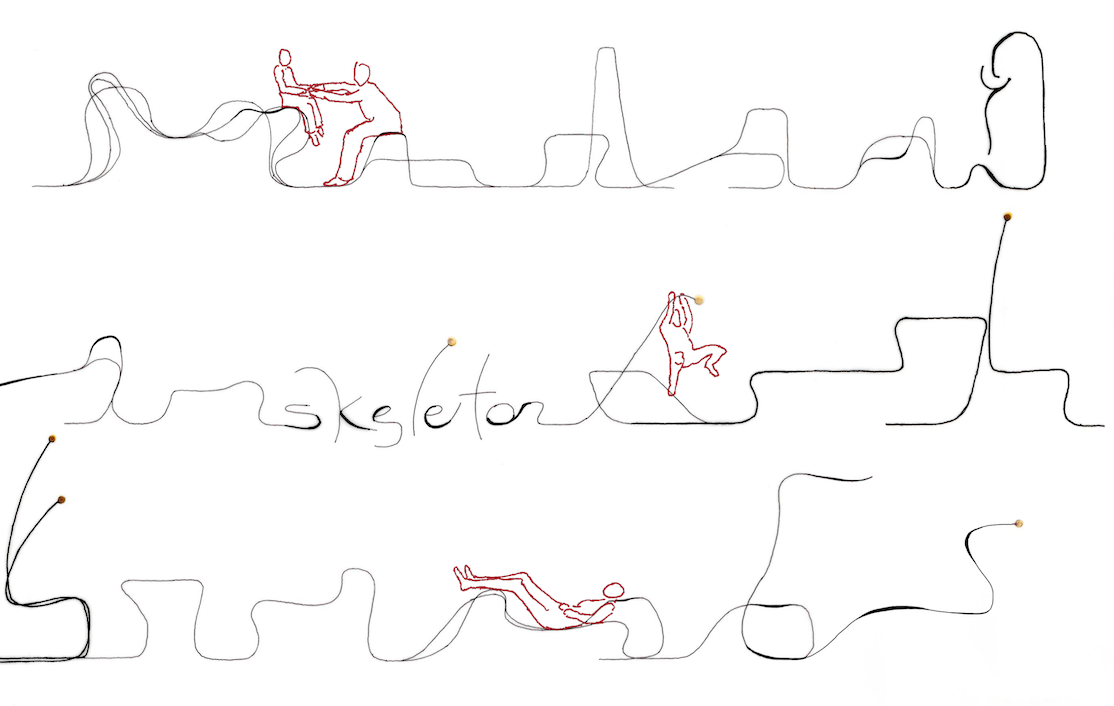
The final gesture of the project was to submit a hand-drawn A1 drawing to an international competition in the era of artificial intelligence. The drawing was not intended as nostalgia, but as a way of thinking through the body. Drawing by hand allowed the form to remain open, imprecise, and responsive, much like the chair itself.
The Living Chair is not an object to be consumed, but a habitable condition. A chair-landscape that moves from the body to the city, proposing a more intimate, playful, and caring way of being together in urban space.