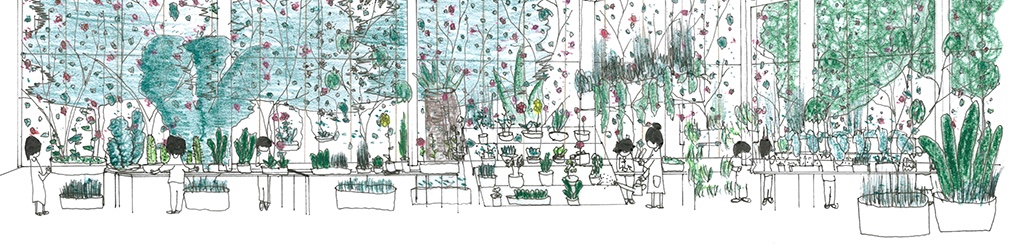

Pavillon de verre, Montréal – Lacaton & Vassal, Frédéric Druot architectes associés à FABG
Every design decision, what students hear, see, and feel, plays a role in their ability to learn. School design, often with its emphasis on efficiency over humanity, has impeded these connections. But what if we could bridge that gap? What if we could design learning environments that honored both our technological needs and our biological inheritance, spaces that felt as nourishing as a walk in the woods yet as functional as any modern classroom?
There were times when my classroom used to feel like a pressure cooker. I noticed the signs of overwhelm everywhere: fluorescent lights buzzed overhead, the air was stale, and students fidgeted, covered their ears, or tuned out completely. In my classroom, neurodivergent learners, in particular those diagnosed with autism, ADHD, or anxiety, the environment often proved to be overwhelming. For others, the strain of a long school day showed in smaller ways, slumped shoulders, daydreaming, restlessness. Still others, without any diagnosis, simply shut down under the sensory load of a typical school day.
I began to see this problem differently. Overwhelm was not just about student “behavior”, it was about design. The environment was shaping student experiences as much as my teaching was. Once I began introducing natural elements and softer lighting, everything shifted. My students grew calmer, more engaged, and better able to learn. What I experienced in my classroom reflects a much bigger truth: architecture and design are deeply intertwined with how students feel, focus, and succeed.
The Science Behind Biophilic Design
The concept of integrating nature into learning spaces isn’t revolutionary, it’s biological. The biophilia hypothesis, introduced by psychoanalyst Erich Fromm and later popularized by biologist Edward O. Wilson, posits that humans possess an innate tendency to seek connections with nature and other forms of life. Wilson defines biophilia as “the innate tendency to focus on life and lifelike processes.” Our well-being is deeply intertwined with our relationship to the natural world.
In educational settings, biophilic design employs strategies such as visual connections to nature, incorporation of plant life, diffused lighting, and biomorphic patterns to recreate elements of the natural world indoors. These design elements not only enhance the aesthetic appeal of learning environments but also contribute to improved mood, concentration, and creativity among students.
Studies show that even brief exposure to nature, whether through outdoor play, greenery around schools, or even images of natural scenes, can lower anxiety, restore attention, and improve mood. One study found that children who attended schools with greener play areas had better working memory and less inattentiveness. A study published by Nature England highlighted that students had increased concentration levels (up 15%) and higher test scores (improved by as much as 25%) when their learning environments included direct exposure to nature.
What Overwhelm Looks Like
Sensory overwhelm happens when the brain cannot keep up with incoming information. In schools, the list of triggers is long: buzzing lights, echoing voices, hot air, constant motion. Children with autism or ADHD are especially sensitive to these factors, but the truth is, all kids are vulnerable.
Noise is one culprit. Research shows that classrooms with high levels of background sound and echo make it harder for children to process speech and concentrate. Air quality is another. When carbon dioxide builds up in crowded classrooms, students feel foggy and tired. Even lighting matters. Flickering fluorescents have been linked to headaches and agitation, while too little natural light during the day can disrupt sleep and mood.
In other words, sensory overwhelm is not just about “the busy world we live in.” It is about how we design the spaces where kids spend most of their waking hours.
The Role of Architecture in Education
The design of a school does more than house learning. It actively influences it. From air quality to acoustics, every element of a classroom shapes student well-being. Poor ventilation increases fatigue. Fluorescent lighting can trigger headaches. Noisy environments heighten stress. Look at how various other cultures, such as the Openluchtschool in Amsterdam, designed by Jan Duiker and Piet Bijvoet in 1927, is a landmark of the open-air school movement that used sunlight, fresh air, and innovative modernist design to promote children’s health and wellbeing in education. Designed learning spaces, often outdoors, always connected to natural rhythms, invariably incorporating elements like natural light, organic materials, and views of living landscapes. As referenced in The Urbanism of School Design, the school was conceived not as a building but as a living system, where learning was inseparable from comfort, sensory experience, and connection to nature.
Some schools are catching on. Open plan classrooms encourage collaboration. Flexible seating supports movement. Architects are integrating features that promote calm and focus. Natural light is now recognized as a cornerstone of good design. One study found that students in classrooms with ample daylight progressed twenty percent faster in math and twenty six percent faster in reading compared to peers in dimly lit rooms.
In my classroom, I found myself improvising with these same principles. I softened school acoustics with rugs. I placed an air filter in the corner. I introduced plants where I could. I dimmed the harsh fluorescents with lamps. If my classroom had enough windows, we would be fortunate enough to have a classroom filled with natural light with no need for artificial light at all. Each adjustment was small, but together they created a space where students could focus without fighting their environment.
Another step I took was simple: I brought in plants. A few pothos on the windowsill, a snake plant in the corner, a hanging fern by my desk. Students noticed right away. They gravitated toward the greenery, and more than one child asked if they could sit near the “plant corner” during independent work.
I added a soft rug, plushies, and a lamp with a warm shade. Soon, students were asking if they could sit there during a more challenging unit, or simply decompressing there. They would spend anywhere from a few minutes to a class period there, then return to their desks calmer and more focused.
This instinctive response has deep roots. Nature acts as a reset button for the nervous system. When classrooms don’t have access to outdoor views, even a few houseplants, calm lighting, and natural textures or elements can make a meaningful difference. For my students, the plants were a living reminder of calm amid sensory chaos.
Lighting That Works With Students, Not Against Them
Let’s talk more about lighting. Like most schools, the ones I’ve worked in have relied on harsh fluorescent grids. In the mornings, we’d try to take a short walk outside under the natural sunlight, and once back in the classrooms, we’d keep our blinds open and lights off for as long as possible. In the afternoons, when natural light waned, we used warm bulbs and dimmers, and students seemed to ease into the natural rhythm of the day. Lighting research explains why. Natural daylight has been shown to improve concentration, mood, and learning outcomes. Exposure to good morning light also supports healthy sleep cycles, critical for teens, who are already prone to late nights. On the flip side, harsh artificial lighting can cause discomfort and agitation. Even the color of light matters: cooler tones in the morning help with focus, while warmer tones later in the day encourage relaxation. By treating light as a tool rather than just a necessity, I was able to create a classroom environment that works with students’ biology, rather than against it.
Why This Matters
For my autistic students, the predictable cues of plants, soft textures, and warm light provided safety. Instead of fighting the sensory chaos of the room, they could retreat to a space that supported regulation. For students with ADHD, the greenery offered a much-needed attention reset. Outdoor breaks or even just a glance at the trees outside helped them return to tasks with renewed focus.
And for those with anxiety, the calmer lighting and natural elements reduced agitated feelings. What might have been a meltdown moment often softened into a manageable pause. The truth is, these changes were not just about supporting neurodivergent learners. They made the classroom better for everyone.
What surprised me most is how little it cost to transform the space. A few plants, a couple of lamps, a rug, and some intentional use of daylight completely shifted the feel of the classroom. The results were calmer afternoons, fewer meltdowns, more focus, and a teacher (me) who felt more at ease too.
Beyond the Classroom: Outdoor Learning Spaces
If a few plants could make such a difference indoors, what happens when we step outside altogether? Increasingly, schools are experimenting with outdoor classrooms, garden-based learning, and natural play areas. Research shows that time outdoors improves attention spans, reduces stress, and enhances problem-solving skills. A study published in 2019 found that children who had lessons outdoors showed improved working memory and reduced symptoms of inattention.
I saw glimpses of this when I moved lessons outside. Even something as simple as reading under a tree or sketching in the courtyard changed the energy. Students who struggled to stay still indoors became absorbed in their work outdoors. The natural environment offered sensory regulation without me having to orchestrate it.
Schools that embrace this more fully are reimagining education. Some build amphitheater-style outdoor classrooms. Others cultivate vegetable gardens tied into science or nutrition lessons. Each example points to the same conclusion: learning thrives when nature is part of the curriculum, not separate from it.
A Playbook for Teachers
Here are some of the simplest ways any educator can start:
- Bring in plants. Even one or two make a difference. Place them where students can see them easily.
- Use natural imagery. Posters or murals of forests, sky, or water help when views are limited.
- Add soft lighting. Desk and floor lamps create warmer, calmer zones.
- Re-seat for daylight. Put sensitive students near windows or softer light.
- Create a refuge corner. A rug, a plant, and a lamp can become a regulation space.
- Mind the air. Open windows when possible or add a small air purifier.
- Soften the noise. Rugs, curtains, or bookcases along walls can help.
Schools are rarely designed with sensory health in mind, yet every child, and every teacher, brings a nervous system into the room. That system can be overwhelmed by noise, light, and air, or it can be soothed by thoughtful design. Architecture, nature, and pedagogy are not separate disciplines; they are partners in creating the conditions for learning. The future of education lies in spaces that are not only functional but humane, places where light, air, and nature nurture both academic and emotional growth.
Citations/Links
1. Heschong Mahone Group (1999) – Daylighting in Schools
2. Coleman et al. (2019) – Virtual Reality Assessment of Classroom-Related Attention
3. Cortese et al. (2015) – Effectiveness of Cognitive Training for School-Aged Children with ADHD
4. Barton et al. (2019) – Do Experiences With Nature Promote Learning?
5. Jarraya et al. (2019) – Kindergarten-Based Yoga Practice
6. https://biologyinsights.com/what-is-the-biophilia-hypothesis-why-does-it-matter/
7.https://biophilicflair.com/nature-inspired-learning-biophilic-design-in-schools-and-universities/
8. https://www.britannica.com/science/biophilia-hypothesis