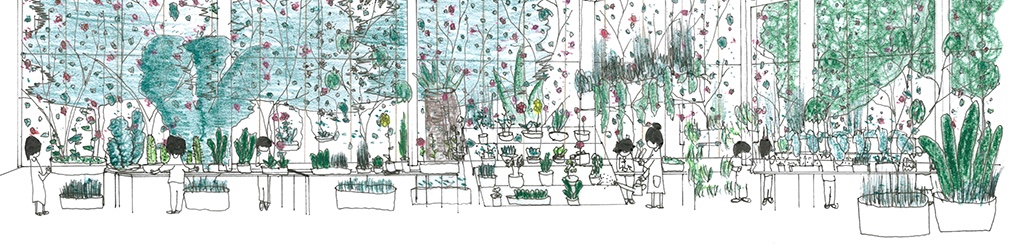

Pavillon de verre, Montréal – Lacaton & Vassal, Frédéric Druot architectes associés à FABG
Every design decision, what students hear, see, and feel, plays a role in their ability to learn. School design, often with its emphasis on efficiency over humanity, has impeded these connections. But whatEvery design decision, what students hear, see, and feel, plays a role in their ability to learn. School design, often prioritizing standardization over student well-being, has impeded these connections. But what if we could bridge that gap? What if we could design learning environments that honored both our technological needs and our biological inheritance, spaces that felt as nourishing as a walk in the woods yet as functional as any modern classroom?
Even in a highly interactive classroom, a natural burnout inevitably sets in as the day goes on. The environment itself becomes a slow drain on everyone’s energy. For neurodiverse students, this environmental strain is magnified, where what feels like standard classroom fatigue for one student can quickly become an absolute sensory overload for another. Whether a child has a specific diagnosis or is simply trying to power through the day, the sheer weight of the physical space, from the quality of the light to the staleness of the air, silently dictates how much energy they have left to learn.
Shifting the focus from student behavior to environmental design offers a completely new framework for addressing classroom burnout. Overwhelm is rarely just an internal struggle; it is a predictable reaction to a high-stimulus space. In practice, when a standard classroom is intentionally modified with natural elements and softer lighting, the atmosphere shifts almost immediately. The room naturally becomes calmer, students become more organically engaged, and focus returns. This real-world transition reflects a much larger truth: architecture and design are deeply intertwined with how students feel, focus, and succeed.
The Science Behind Biophilic Design
Integrating nature into learning spaces is an act of biological alignment rather than a modern invention. The biophilia hypothesis, introduced by psychoanalyst Erich Fromm and later popularized by biologist Edward O. Wilson, posits that humans possess an innate tendency to seek connections with nature and other forms of life. Wilson defines biophilia as “the innate tendency to focus on life and lifelike processes.” Our well-being is deeply intertwined with our relationship to the natural world.
In educational settings, biophilic design employs strategies such as visual connections to nature, the incorporation of plant life, diffused lighting, and biomorphic patterns to recreate elements of the natural world indoors. These design elements not only enhance the aesthetic appeal of learning environments but also contribute to improved mood, concentration, and creativity among students.
Studies show that even brief exposure to nature, whether through outdoor play, greenery around schools, or even images of natural scenes, can lower anxiety, restore attention, and improve mood. One study found that children who attended schools with greener play areas had better working memory and less inattentiveness. Furthermore, a study published by Natural England highlighted that students had increased concentration levels by 15% and higher test scores, which improved by as much as 25%, when their learning environments included direct exposure to nature.
Overwhelm
While direct exposure to nature is linked to better academic outcomes, many standard classrooms present environmental challenges that can contribute to sensory overwhelm. Features like background hums from lighting, poor acoustics, inadequate ventilation, and constant movement can accumulate as subtle distractors throughout the day. While these factors can be particularly challenging for neurodiverse students, they can create an underlying strain for any child. Filtering out constant ambient noise requires mental effort, and poor air quality or harsh lighting can leave students feeling drained. Ultimately, a child’s restlessness or fatigue is rarely just a matter of choosing not to focus; rather, an uncomfortable or overstimulating physical space can simply make it much harder for them to manage the everyday physical, social, and emotional demands of growing up.
The Role of Architecture in Education
The design of an educational facility does far more than house learning; it actively influences it. From air quality to acoustics, every element of a physical classroom shapes student well-being. Poor ventilation contributes to fatigue, standard fluorescent lighting can trigger headaches, and noisy environments frequently heighten stress. This understanding is not entirely new; historically, various cultures have recognized the impact of architecture on development. For example, the Openluchtschool in Amsterdam, designed by Jan Duiker and Piet Bijvoet in 1927, is a landmark of the open-air school movement that used sunlight, fresh air, and innovative modernist design to promote children’s health and wellbeing in education. The school utilized sunlight, fresh air, and innovative modernist design to promote health within education. As referenced in Urbanism of School Design, The Urbanism of School Design, the facility was conceived not merely as a building, but as a living system where learning was inseparable from physical comfort, sensory experience, and a connection to nature.
Today, contemporary school design is increasingly reflecting these principles. Open-plan layouts encourage collaboration, flexible seating supports natural movement, and architects are integrating features specifically intended to promote calm and focus. Natural light, in particular, is recognized as a cornerstone of effective environments. Research indicates that students in classrooms with ample daylight progress 20% faster in mathematics and 26% faster in reading compared to peers in poorly lit spaces.
In practice, educators often find themselves improvising with these same concepts to support their students. Introducing soft rugs can improve classroom acoustics, while strategic air filtration and alternative lighting, such as warm lamps instead of harsh fluorescents, help mitigate environmental stressors. Classrooms with sufficient windows can rely primarily on natural daylight, reducing the need for artificial sources entirely. Even small adjustments, like adding resilient houseplants such as pothos or snake plants, can noticeably alter the atmosphere. Students frequently gravitate toward these natural elements, seeking out seating near greenery or utilizing designated quiet areas with soft textures and warm lighting to decompress during challenging tasks. These instinctive responses underscore how even modest introductions of natural textures, calm lighting, and living plants can act as a meaningful buffer against daily sensory chaos.
Lighting in Harmony with Biology
The quality of classroom lighting plays a significant role in student engagement and physiological regulation. Standard educational facilities traditionally rely on overhead fluorescent grids, which can often cause physical discomfort or agitation. Utilizing natural daylight as the primary source of visibility has been shown to improve concentration, stabilize mood, and enhance overall learning outcomes. Furthermore, exposure to natural morning light supports healthy circadian rhythms and sleep cycles, which is a critical factor for adolescents who are biologically prone to later sleep schedules. In fact, data from the Lighting Research Center highlights that a lack of adequate morning light during the school day actively delays melatonin onset, compounding sleep restriction for middle school students.
In practice, aligning classroom lighting with these natural rhythms can create a more supportive environment. Incorporating outdoor morning walks or maximizing daylight by keeping blinds open and overhead lights off establishes an early foundation for focus. As afternoon light wanes, transitioning to warm, dimmable secondary lighting helps students ease naturally into the later hours of the day. The color temperature of light also serves as a strategic tool, where cooler tones in the morning assist with cognitive focus, and warmer tones later in the day encourage physical relaxation. By treating light as an active environmental variable rather than a static necessity, the physical classroom can work in tandem with student biology rather than against it.
Reimagining the Classroom Beyond Four Walls
If modest interior adjustments can noticeably alter student behavior, the impact increases significantly when learning moves entirely outdoors. Educational institutions are increasingly implementing outdoor classrooms, garden-based learning initiatives, and natural play spaces. Research indicates that regular time spent outdoors improves attention spans, mitigates stress, and enhances problem-solving skills. For instance, a 2019 study published in the International Journal of Environmental Research and Public Health found that children participating in outdoor lessons demonstrated improved working memory and a notable reduction in symptoms of inattention.
This shift in engagement is often evident during simple transitions to outdoor instruction, such as conducting reading sessions beneath a tree or utilizing a courtyard for sketching exercises. The natural environment inherently provides sensory regulation, allowing students who typically experience restlessness indoors to become deeply absorbed in their tasks.
School systems that fully embrace these principles are effectively reimagining the structure of education. Some facilities construct amphitheater-style outdoor classrooms, while others develop vegetable gardens that integrate directly into science and nutrition curricula. These varied approaches reinforce a central conclusion, which is that academic learning thrives when nature is treated as an essential component of the educational environment rather than an occasional exception.
Practical Strategies for the Classroom
While systemic architectural changes take time, educators can immediately implement accessible adjustments to optimize their current spaces. The following strategies provide a foundational framework for enhancing the sensory environment:
- Introduce Resilient Greenery: Placing even a few hardy plants where students can easily see them introduces a grounding, natural element to the room.
- Incorporate Natural Imagery: Utilizing posters, artwork, or murals depicting forests, skies, or water features helps mitigate the effects of limited outdoor views.
- Utilize Secondary Lighting: Adding desk or floor lamps with warm bulbs creates calmer, more inviting zones that soften the impact of overhead fixtures.
- Optimize Seating for Daylight: Arranging desks so that students who are highly sensitive to light are positioned near windows or areas with softer illumination can improve comfort.
- Designate a Sensory Refuge: Creating a quiet corner with a small rug, a plant, and a warm lamp establishes a dedicated space for emotional and physiological regulation.
- Manage Air Quality: Opening windows when weather permits or introducing a small air purifier can noticeably reduce stuffiness and fatigue.
- Soften Classroom Acoustics: Placing rugs, fabric curtains, or bookcases along bare walls helps absorb excess sound and reduces overall auditory chaos.
Designing a Humane Future for Education
Standard educational facilities are rarely engineered with sensory health as a primary consideration, yet every student and educator brings a sensitive nervous system into the classroom daily. These physiological systems can either be chronically overwhelmed by poor acoustics, harsh lighting, and stagnant air, or they can be profoundly supported by intentional environmental design.
Architecture, natural ecology, and pedagogy are not separate disciplines; instead, they operate as interconnected partners in establishing the essential conditions for academic success. The future of education relies on developing learning environments that are both functional and humane, ensuring that light, air, and nature work together to nurture both academic capability and emotional growth.
Citations/Links
1. Heschong Mahone Group (1999) – Daylighting in Schools
2. Coleman et al. (2019) – Virtual Reality Assessment of Classroom-Related Attention
3. Cortese et al. (2015) – Effectiveness of Cognitive Training for School-Aged Children with ADHD
4. Barton et al. (2019) – Do Experiences With Nature Promote Learning?
5. Jarraya et al. (2019) – Kindergarten-Based Yoga Practice
6. https://biologyinsights.com/what-is-the-biophilia-hypothesis-why-does-it-matter/
7.https://biophilicflair.com/nature-inspired-learning-biophilic-design-in-schools-and-universities/
8. https://www.britannica.com/science/biophilia-hypothesis