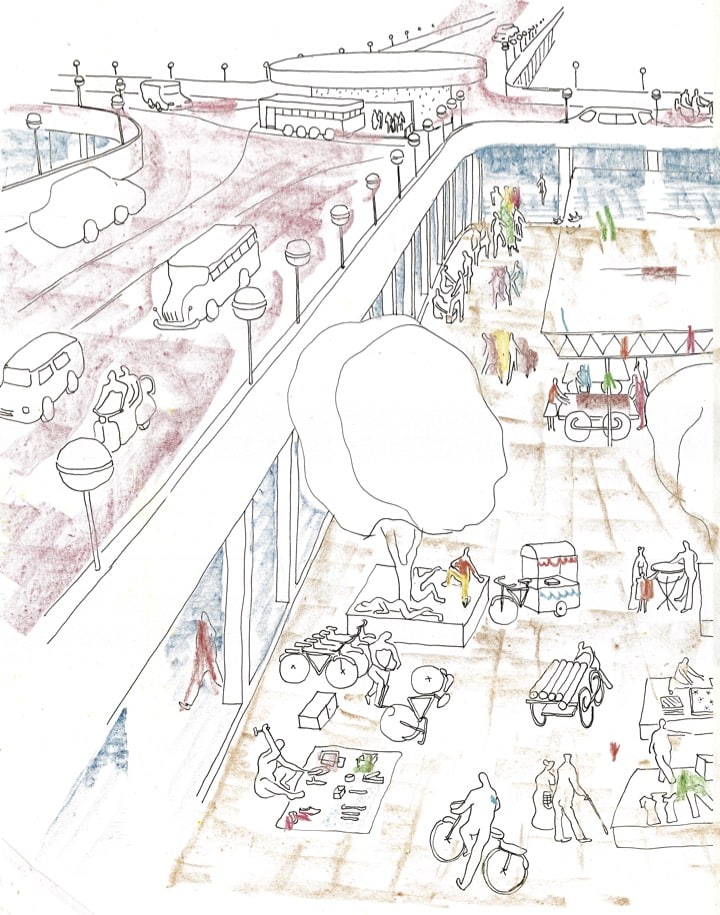
On race weekends, Eddyville Raceway Park bears little resemblance to the small Iowa community that surrounds it. Throughout the day, hundreds of spectators, drivers, crew members, vendors, and families move through the grounds. Conversations unfold in the pit area as people stop to admire race cars, motorcycles, and trucks. Children watch mechanics prepare vehicles for competition while strangers introduce themselves and exchange stories about previous races. As each pair of racers approaches the starting line, attention shifts collectively toward the track before gradually dissolving back into conversation. By evening, however, the crowd is gone. The trailers have departed, the vendors have packed their stands, and the raceway returns to its ordinary rhythm.
Watching this transformation unfold week after week, I found myself thinking less about drag racing than about the temporary community that formed around it. Nothing about the physical setting had fundamentally changed, yet for a few hours the raceway had become the center of a much larger social world. I began noticing the same rhythm while conducting ethnographic research at Pella’s Annual Tulip Time Festival, Oskaloosa’s Art on the Square, Oskaloosa’s PRIDE on the Square, Lake Red Rock BalloonFest, Oskaloosa’s Sweet Corn Serenade, and Oskaloosa’s BBQ 4 Badges. Although these gatherings celebrated different aspects of community life, they each transformed an ordinary place into a temporary center of public life before gradually returning it to its everyday routine.
Urban sociologists have long associated urbanity with cities, emphasizing density, heterogeneity, infrastructure, and public space as the conditions that make urban life possible (Park 1915; Wirth 1938; Jacobs 1961; Whyte 1980; Gehl 2011). Those perspectives explain a lot about cities, but they miss the point of this essay. Why do many of the same experiences emerge in communities far removed from metropolitan centers? Why can a drag strip outside a town of just over one thousand residents, or a courthouse square in rural Iowa, briefly generate many of the qualities we associate with urban life?
The answer, I came to believe, lies less in the places themselves than in what people do together. Urbanity is not simply a feature of the built environment or population size. It is a recurring social accomplishment created whenever communities organize opportunities for strangers to gather, interact, observe one another, and participate in shared public life. I think of these recurring moments as urban performances because, like a theatrical production, they emerge through preparation, intensify through collective participation, recede as the crowd disperses, and persist through memory long after the event has ended.
The first stage of every urban performance begins well before the crowd arrives. Visitors experience Tulip Time as a celebration of Dutch heritage, but they rarely see the months of preparation that make the festival possible. Volunteers rehearse dances, businesses decorate storefronts, civic organizations recruit participants, and city officials coordinate logistics long before the first parade begins. Similar work unfolds elsewhere as artists prepare for Art on the Square, balloon crews monitor weather conditions before BalloonFest, race teams tune vehicles at Eddyville Raceway Park, and volunteers organize food, entertainment, and fundraising for BBQ 4 Badges. Although these gatherings differ dramatically in purpose, they all depend upon preparation that remains largely invisible to participants.
Interaction rituals that are successful must begin before people physically assemble because participants develop a shared focus of attention in advance (Collins, 2004). That insight helps explain why anticipation is such an important part of community life. Long before an event begins, residents discuss it with friends, make plans with family members, share announcements on social media, and reorganize their schedules around participation. Communities begin orienting themselves toward a shared future before they ever occupy the same public space.
When participants finally gather, familiar places take on new meanings. Streets that ordinarily serve as routes through town become destinations where people linger, browse vendor booths, greet acquaintances, and strike up conversations with strangers. Courthouse squares, parks, and sidewalks become places for interaction rather than passage, encouraging people to slow down and participate in the life unfolding around them. This transformation looks different from one event to the next, yet the interactional process remains remarkably consistent. Visitors to Art on the Square move slowly between artists’ booths, pausing to discuss paintings and watch demonstrations. Sweet Corn Serenade encourages residents to remain downtown long after they have finished eating, extending conversations across sidewalks and public seating areas. At Eddyville Raceway Park, spectators wait together for each race, their conversations momentarily giving way to collective attention as the starting lights count down before resuming almost immediately afterward. During PRIDE on the Square, downtown Oskaloosa becomes a visible celebration of identity and belonging, creating opportunities for encounters among friends, neighbors, and strangers within a shared public setting (Lofland 1998).
Across these very different gatherings, physical settings change very little, but the social experience of place changes dramatically. Goffman’s (1959) dramaturgical perspective reminds us that public life depends upon people simultaneously performing for one another while observing others. Durkheim ([1912] 1995) described the emotional energy generated through these moments as collective effervescence, while Simmel ([1903] 1950) emphasized the importance of encounters with strangers in shaping urban experiences. Together, these perspectives suggest that what makes these events feel urban is not population size alone but the temporary concentration of shared attention, interaction, and collective experience.
Eventually, every performance comes to an end. The crowds that transformed these places into centers of public life gradually disperse, and the spaces they occupied return to their everyday rhythms. Artists pack paintings into trailers while race teams load vehicles for the drive home. Spectators drift toward parking lots, lawn chairs disappear, and downtown streets once again become routes through town rather than destinations. The excitement that animated these places throughout the day quietly gives way to familiar routines.
At first glance, these moments might seem like the end of urbanity, but they reveal something different. What disappears is not public life itself but its temporary intensity. Lefebvre (2004) described everyday life as a series of recurring rhythms in which periods of concentration give way to quieter moments before building again. The gatherings I observed followed the same pattern. Their significance lies precisely in the fact that they interrupt ordinary routines before gradually yielding to them again. A courthouse square bustling with artists or a raceway crowded with spectators is memorable because it is not the everyday condition of those places.
This perspective also changes how we think about small towns. Quiet streets are often interpreted as evidence that rural communities lack the vitality commonly associated with cities. My fieldwork suggests a different interpretation. Public life is not absent from these communities; it simply ebbs and flows. The same places that appear quiet on an ordinary weekday can become remarkably vibrant when people gather around a shared purpose. Urbanity, in other words, is less a permanent condition than a recurring rhythm of community life.
The urban performance does not truly end when the crowd goes home. It continues through conversations on the drive home, photographs shared online, and stories exchanged with friends and family in the days that follow. Organizers meet to evaluate what worked well and begin planning the next event. Participants compare this year’s gathering with previous ones and begin talking about returning. The event persists because it remains part of the community’s conversation long after the physical gathering has ended.
Nora (1989) argued that collective memory allows communities to preserve meaningful experiences across time. My fieldwork suggests that community events are among the places where those memories are continually renewed. People return not simply because they enjoyed a festival, race, or concert, but because participation has become woven into friendships, family traditions, and shared expectations about community life. Returning to Tulip Time, Art on the Square, Eddyville Raceway Park, BalloonFest, Sweet Corn Serenade, or BBQ 4 Badges is therefore about more than attending another event. It is about renewing relationships and reconnecting with a community that exists through repeated participation.
Memory also shapes what comes next. Long before another festival or race appears on the calendar, organizers begin recruiting volunteers, securing permits, contacting vendors, and planning entertainment while participants decide when they will return and who will join them. Memory becomes anticipation, linking one gathering to the next and creating a cycle through which communities repeatedly recreate opportunities for public life. The end of one urban performance quietly becomes the beginning of another.
Thinking about these gatherings in this way shifts one of urban sociology’s most enduring questions. Rather than asking whether a place is urban, we might instead ask how communities create moments of urbanity. Across my fieldwork, events as different as a heritage festival, an art fair, a Pride celebration, a drag race, a balloon festival, a summer concert, and a community fundraiser all followed a remarkably similar social rhythm. They brought strangers together, focused collective attention on a shared activity, transformed familiar places into spaces of encounter, and generated memories that encouraged people to return. Their purposes differed, but the interactional process remained strikingly consistent.
This perspective does not diminish the importance of cities. Metropolitan areas provide countless opportunities for these kinds of encounters because of their built environment and residential population. What my fieldwork suggests, however, is that the social processes we often describe as urban are not exclusive to metropolitan environments. Communities of every size can create moments that feel distinctly urban whenever they organize opportunities for people to gather, interact, and participate in shared public life.
When I think back to those weekends at Eddyville Raceway Park, I no longer see only a drag strip outside of Eddyville, Iowa. I see one of several community gatherings that revealed the same underlying social process. Whether at Tulip Time, Art on the Square, Pride Festival, BalloonFest, Sweet Corn Serenade, or BBQ 4 Badges, I repeatedly observed ordinary places becoming temporary sites of encounter, interaction, and shared public life. Urbanity, I came to understand, is not simply a characteristic of cities. It is something communities can collectively accomplish, however briefly, through urban performances.
References
Collins, Randall. 2004. Interaction Ritual Chains. Princeton, NJ: Princeton University Press.
Durkheim, Émile. (1912/1995). The Elementary Forms of Religious Life. Translated by Karen E. Fields. New York: Free Press.
Gehl, Jan. 2011. Life Between Buildings: Using Public Space. Washington, DC: Island Press.
Goffman, Erving. 1959. The Presentation of Self in Everyday Life. Garden City, NY: Doubleday Anchor.
Jacobs, Jane. 1961. The Death and Life of Great American Cities. New York: Random House.
Lefebvre, Henri. 2004. Rhythmanalysis: Space, Time and Everyday Life. Translated by Stuart Elden and Gerald Moore. London: Continuum.
Lofland, Lyn H. 1998. The Public Realm: Exploring the City’s Quintessential Social Territory. New York: Aldine de Gruyter.
Nora, Pierre. 1989. “Between Memory and History: Les Lieux de Mémoire.” Representations 26:7-24.
Park, Robert E. 1915. “The City: Suggestions for the Investigation of Human Behavior in the Urban Environment.” American Journal of Sociology 20(5):577-612.
Simmel, Georg. (1903/1950). “The Metropolis and Mental Life.” Pp. 409-424 in The Sociology of Georg Simmel, translated and edited by Kurt H. Wolff. New York: Free Press.
Whyte, William H. 1980. The Social Life of Small Urban Spaces. Washington, DC: Conservation Foundation.
Wirth, Louis. 1938. “Urbanism as a Way of Life.” American Journal of Sociology 44(1):1-24.